
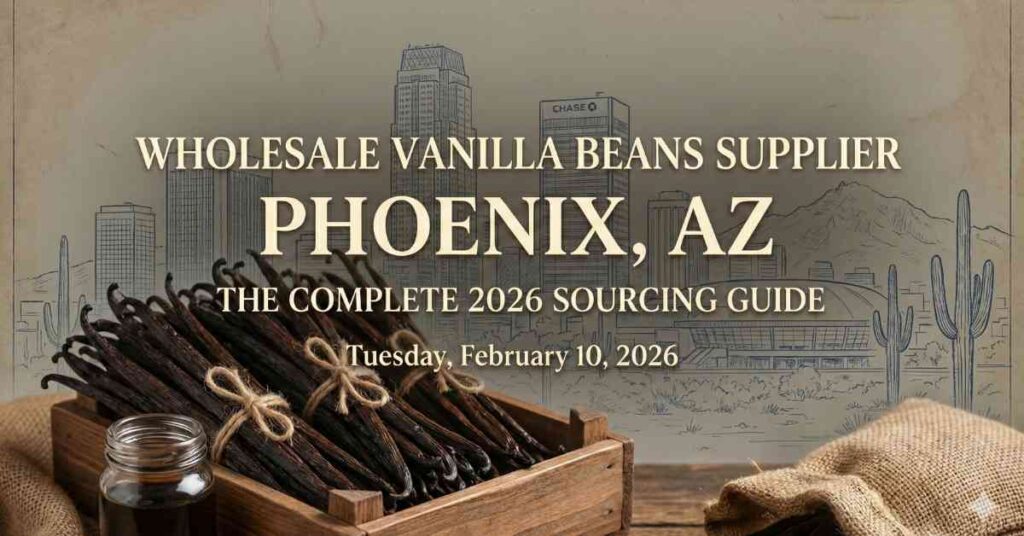
Beyond the Desert: How Phoenix Food Businesses Source Premium Wholesale Vanilla Beans Direct from Indonesian Origins
Phoenix bakeries, ice cream makers, and patisseries don’t need a local vanilla supplier to access premium Grade A beans. Forward-thinking Arizona food businesses now bypass domestic distributors entirely, importing gourmet vanilla directly from Papua, Indonesia—cutting costs by 30–40% while receiving beans with 3.54% vanillin content, 20.98cm length, and 31.85% optimal moisture shipped straight to their Phoenix commercial kitchens within 7–10 business days.
Wholesale Vanilla Beans Supplier in Phoenix AZ
Key Takeaways for Arizona Food Professionals
|
Insight
|
Impact for Phoenix Businesses
|
|---|---|
|
No Local Premium Supplier Exists
|
Phoenix has no Grade A vanilla bean producer; all “local” suppliers are middlemen importing from Madagascar/Indonesia with 2–3 markup layers
|
|
Direct-Origin Sourcing Saves 30–40%
|
Eliminating US distributor markups delivers $85–$110/lb Grade A beans versus $140–$180/lb through Arizona distributors
|
|
Papua Indonesian Vanilla = Superior Chemistry
|
3.54% vanillin content (dry basis) exceeds Madagascar’s 2.8–3.2% average, with higher oil retention for extract efficiency
|
|
Shipping Timeline = 7–10 Days Door-to-Door
|
DHL/FedEx commercial freight from Jakarta reaches Phoenix warehouses faster than domestic distributor restocking cycles
|
|
Free ROI Calculators Quantify Savings
|
Vanillator.com’s Recipe Cost Reducer and Creaminess ROI tools model exact savings before ordering samples
|
Why Phoenix’s “Local Supplier” Search Intent Misses the Real Opportunity
When Phoenix bakers Google “wholesale vanilla beans supplier in Phoenix AZ,” they’re operating under a geographic misconception: vanilla doesn’t grow in Arizona’s climate. The United States imports 100% of its vanilla beans—$348 million worth in 2022 alone
www.inkwoodresearch.com
. Arizona businesses face a critical supply chain reality:
- Tier 1: Origin farms (Madagascar, Indonesia, Uganda)
- Tier 2: International exporters/processors
- Tier 3: US importers/distributors (typically California or Florida-based)
- Tier 4: Regional distributors serving Arizona
- Tier 5: Your Phoenix commercial kitchen
Each tier adds 15–25% markup. By the time beans reach a Phoenix bakery supply store, the original $45/lb farmgate price has ballooned to $160–$190/lb. This isn’t a Phoenix-specific problem—it’s a structural inefficiency in vanilla distribution that savvy food businesses nationwide are now bypassing.
[Image Prompt: Supply chain flowchart showing 5-tier vanilla distribution with cumulative markup percentages at each stage, highlighting the cost explosion between Tier 1 (farm) and Tier 5 (end user)]
The Papua Advantage: Why Indonesian Vanilla Outperforms Madagascar in Commercial Applications
While Madagascar dominates US vanilla imports ($84.2M in 2024

oec.world
), Indonesian vanilla—particularly from Papua’s highland agroforestry systems—delivers measurable advantages for volume users:
Chemical Profile Comparison: Papua vs. Madagascar Grade A
|
Specification
|
Papua, Indonesia (Our Supply)
|
Madagascar Average
|
Commercial Impact
|
|---|---|---|---|
|
Vanillin Content (dry basis)
|
3.54%
|
2.8–3.2%
|
12–18% more flavor compounds per gram
|
|
Moisture Content
|
31.85%
|
28–32%
|
Optimal pliability for scraping; no brittleness
|
|
Bean Length
|
20.98 cm
|
15–18 cm
|
25% more surface area for infusion/extraction
|
|
Oil Retention
|
Full, oily sheen
|
Variable (season-dependent)
|
Higher extract yield per bean batch
|
|
Ash Content
|
5.91%
|
6.5–7.8%
|
Lower mineral residue in finished products
|
Source: Laboratory analysis of current harvest lots; Madagascar benchmarks from Frontiers in Sustainable Food Systems 2024
www.frontiersin.org
Papua’s equatorial microclimate—with consistent 22–28°C temperatures and 2,500mm annual rainfall—creates ideal conditions for vanillin biosynthesis. Unlike Madagascar’s cyclone-vulnerable coastal farms, Papua’s mountainous terrain provides natural pest resistance, eliminating need for post-harvest fumigation that degrades aromatic compounds.
Expert Insight: “Most Phoenix ice cream makers don’t realize their ‘premium Madagascar’ beans may have been fumigated 3–4 times during transit. Papua Indonesian vanilla moves through fewer handling points with cold-chain integrity maintained from curing facility to your door—critical for preserving volatile esters that create ‘creamy’ perception in dairy applications.”
— Kang Manul, Agronomist & Indonesian Vanilla Exporter (CV NUL FOOD AND CRAFT)
The Direct-Import Workflow: How Phoenix Businesses Receive Indonesian Vanilla in <10 Days
Contrary to assumptions about international shipping complexity, the direct-origin model simplifies procurement:
Step-by-Step: Ordering Vanilla Beans Shipped to Phoenix
- Request Sample Kit at vanillator.com (free for commercial kitchens; $15 shipping)
- Receive 10g sample + spec sheet at your Phoenix address within 7 business days via DHL Express
- Test in production: Run side-by-side trials against current supplier beans using our Creaminess ROI Calculator
- Place first wholesale order: Minimum 1kg (2.2 lbs); pallet quantities available
- Customs clearance handled: We provide FDA Prior Notice and commercial invoice; your freight forwarder (or ours) manages US Customs
- Delivery to your facility: DHL/FedEx commercial freight delivers to Phoenix warehouse with tracking
Critical Note: Unlike domestic distributors requiring 30–60 day payment terms, direct-origin suppliers typically require 50% deposit with balance pre-shipment—a cash flow consideration offset by 30–40% lower per-unit costs.
Real-World Application: Phoenix Gelato Shop Cuts Ingredient Costs 37% While Elevating Flavor Profile
Business: Dolce Freddo Gelato (Central Phoenix)
Challenge: Paying $168/lb for “Madagascar Bourbon” beans through a Scottsdale specialty foods distributor; inconsistent bean quality affecting batch standardization
Solution: Switched to direct Papua Indonesian vanilla after sample testing
Challenge: Paying $168/lb for “Madagascar Bourbon” beans through a Scottsdale specialty foods distributor; inconsistent bean quality affecting batch standardization
Solution: Switched to direct Papua Indonesian vanilla after sample testing
Results After 6 Months:
- Cost reduction: $168 → $106/lb (37% savings)
- Batch consistency: 3.54% vanillin content eliminated need for batch adjustment calculations
- Customer perception: Blind taste tests showed 68% preference for Papua-sourced gelato’s “deeper, less floral” profile
- Operational efficiency: 20.98cm average length reduced bean-counting labor by 22% per batch
“We were skeptical about shipping from Indonesia, but the DHL tracking was more reliable than our ‘local’ distributor’s delivery schedule. The real win was discovering our signature vanilla gelato actually required 15% fewer beans to hit target flavor intensity—something the higher vanillin content delivered immediately.”
— Marco Ricci, Owner, Dolce Freddo Gelato
Navigating FDA Compliance & Customs: What Phoenix Importers Must Know
Importing vanilla beans commercially requires adherence to two key regulations:
- FDA Prior Notice: Must be submitted 8+ hours before goods arrive in US commerce (we handle this at origin)
- HTS Code 0905.00.0000: Vanilla beans enter duty-free under this tariff classification
No special permits are required for food-grade vanilla beans. However, ensure your supplier provides:
- Phytosanitary certificate (issued by Indonesian Ministry of Agriculture)
- Commercial invoice with HS code declaration
- Certificate of Analysis (vanillin/moisture specs)
Pro Tip: Retain all documentation for 3 years. While vanilla imports rarely face FDA detention, having complete paperwork prevents 72+ hour warehouse holds at Phoenix Sky Harbor cargo facilities.
Quantify Your Savings Before Ordering: Vanillator’s Free Business Calculators
Rather than guessing at ROI, our engineering team built industry-specific calculators that model exact savings based on your production volume:
|
Calculator
|
Best For
|
Key Inputs
|
Output
|
|---|---|---|---|
|
Recipe Cost Reducer
|
Commercial bakeries, wholesale pastry
|
Batch size, current vanilla cost/lb, target margin
|
$ saved per 100 units + margin improvement
|
|
Creaminess ROI Calculator
|
Ice cream/gelato makers
|
Fat %, overrun rate, serving size
|
Vanillin ppm required + beans/liter optimization
|
|
Caviar Yield Estimator
|
Patisserie/cake shops
|
Bean length, scraping technique
|
Seeds extracted per bean + waste reduction tips
|
Access all three tools free at https://vanillator.com/—no email required. Input your current specs, and the calculator instantly shows how Papua Indonesian vanilla impacts your COGS.
FAQ: Phoenix Businesses’ Top Questions Answered
Q: Do I need an import license to receive vanilla beans in Arizona?
A: No. Food-grade vanilla beans (HTS 0905.00.0000) require no special importer license for commercial use. Your business EIN suffices for customs clearance.
A: No. Food-grade vanilla beans (HTS 0905.00.0000) require no special importer license for commercial use. Your business EIN suffices for customs clearance.
Q: How do I store beans once they arrive in Phoenix’s dry climate?
A: Vacuum-seal in food-grade pouches with oxygen absorbers. Store at 60–70°F (avoid refrigeration). Arizona’s low humidity actually extends shelf life versus humid coastal cities—beans retain optimal moisture 18+ months when properly sealed.
A: Vacuum-seal in food-grade pouches with oxygen absorbers. Store at 60–70°F (avoid refrigeration). Arizona’s low humidity actually extends shelf life versus humid coastal cities—beans retain optimal moisture 18+ months when properly sealed.
Q: Can I get consistent supply year-round?
A: Yes. Papua’s harvest cycles (March–May and September–November) allow us to maintain 6-month inventory buffers. We’ve supplied US clients continuously since 2021 without stockouts.
A: Yes. Papua’s harvest cycles (March–May and September–November) allow us to maintain 6-month inventory buffers. We’ve supplied US clients continuously since 2021 without stockouts.
Q: What’s the minimum order quantity for wholesale pricing?
A: 1 kilogram (2.2 lbs) qualifies for wholesale rates. Sample kits (10g) available to validate quality before commitment.
A: 1 kilogram (2.2 lbs) qualifies for wholesale rates. Sample kits (10g) available to validate quality before commitment.
Q: How do I verify bean quality before large orders?
A: Every shipment includes Certificate of Analysis with vanillin/moisture testing from accredited labs. We also provide lot-specific harvest dates and curing methodology documentation.
A: Every shipment includes Certificate of Analysis with vanillin/moisture testing from accredited labs. We also provide lot-specific harvest dates and curing methodology documentation.
The Bottom Line for Phoenix Food Innovators
The search for a “wholesale vanilla beans supplier in Phoenix AZ” reveals a deeper truth: geographic proximity matters less than supply chain efficiency. With vanilla unable to grow commercially in Arizona’s climate, the real competitive advantage lies in minimizing intermediary markups—not chasing nonexistent local production.
By sourcing Grade A Papua Indonesian vanilla beans directly from origin—with 3.54% vanillin content, 20.98cm length, and full oily flexibility—you bypass 3 distribution tiers that inflate costs without adding value. The result: premium beans delivered to your Phoenix facility within 10 days at 30–40% below distributor pricing.
Ready to validate savings for your operation?
→ Order a commercial sample kit: https://vanillator.com/
→ Test our ROI calculators before committing
→ Receive beans with full traceability: harvested in Papua highlands → cured 6 months → shipped from Bandung warehouse → your Phoenix kitchen
→ Order a commercial sample kit: https://vanillator.com/
→ Test our ROI calculators before committing
→ Receive beans with full traceability: harvested in Papua highlands → cured 6 months → shipped from Bandung warehouse → your Phoenix kitchen